
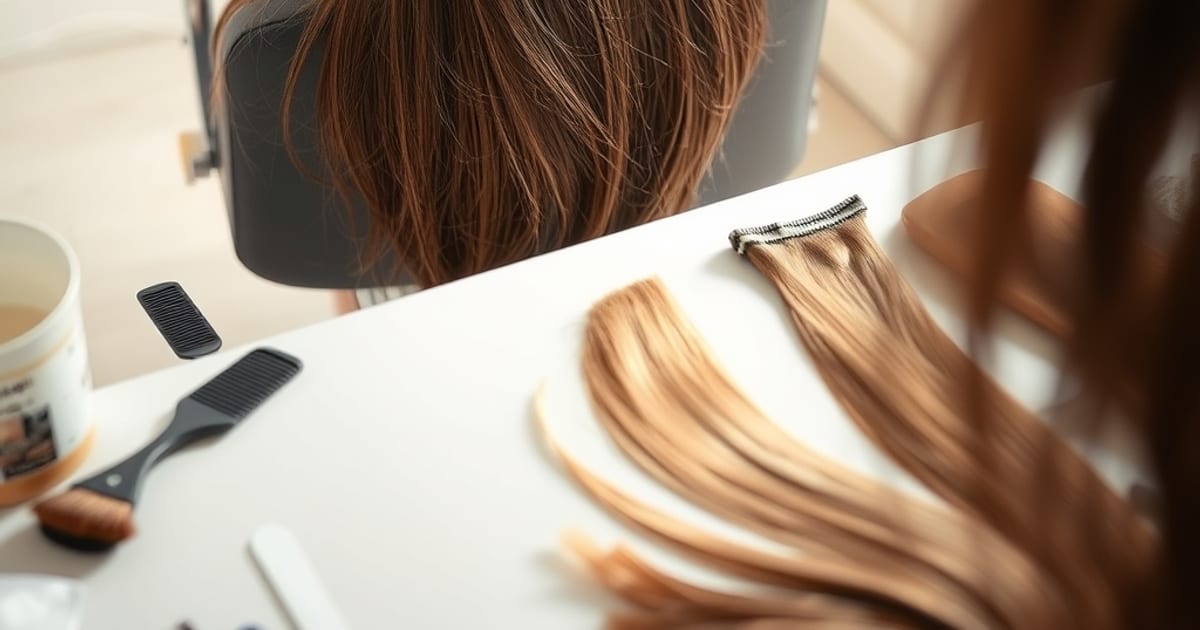
Extension removal is one of the most overlooked skills in professional hair artistry. Yet it is arguably as important as the installation itself. When performed incorrectly or…
Extension removal is one of the most overlooked skills in professional hair artistry. Yet it is arguably as important as the installation itself. When performed incorrectly or rushed, removal can cause unnecessary tension, breakage, and scalp irritation — all of which reflect poorly on the salon and erode client trust. Whether you work with tape-ins, sew-ins, clip-ins, or bonded applications, understanding the correct method for each type is essential to preserving both the integrity of the hair and the health of the client's natural growth. At Suvita Hair Global, we manufacture and export premium 100% Virgin Remy Indian human hair extensions, and we believe that proper removal technique begins long before the adhesive or the needle touches the scalp — it begins with knowing the product you are working with.
Understanding Your Installation Type
Before reaching for any solvent, tool, or method, the salon professional must first identify the type of installation in place. Each system demands a distinct approach, and applying the wrong technique can damage both the extension and the client's natural hair. Below is a breakdown of the most common installation types and the principles that govern their safe removal.
Tape-In Extensions
Tape-in extensions are among the most popular installs in salons worldwide because of their seamless finish and lightweight feel. Removal requires a specialised adhesive remover designed specifically for tape bonds. The process involves saturating the bond area, allowing the solvent to break down the adhesive, and then gently sliding the weft out from the root. Rushing this step by pulling or tugging is the single most common cause of tape-in damage. Professional stylists should work section by section, ensuring each bond is fully dissolved before moving to the next. With extensions manufactured by Suvita Hair Global, the flat, uniform weft structure allows for smoother separation during removal, reducing the risk of snagging on the client's natural hair.
Sew-In and Weft Installations
Sew-in extensions, also referred to as weave installations, are secured by stitching a weft onto braided or cornrowed base hair. Removal is a careful, methodical process that begins with undoing the braids without pulling on the extensions themselves. Once the braids are released, the stitches holding the weft in place must be cut or unpicked with precision. The key is to keep constant tension on the weft as you release each stitch so that the hair does not spring back and tangle. Because sew-in installations from Suvita Hair Global use single, double, or machine-wefted constructions with reinforced edges, the wefts hold their shape throughout the wear period and release cleanly when the stitches are properly undone.
Clip-In Extensions
Clip-in extensions are the most client-friendly option for both application and removal. Each clip is designed to open and close with a simple squeeze mechanism. Removal involves unclipping each section individually, starting from the nape and working upward. The stylist should hold the natural hair near the clip to prevent the extension from pulling away from the roots. Because clip-ins from Suvita Hair Global feature medical-grade aluminium clips with smooth, rounded edges, they glide through the natural hair without catching or tearing, making the removal process swift and comfortable for the client.
Glue and Micro-Ring Applications
Bonded extensions using either liquid glue or micro-ring bead attachments require the most specialised removal expertise. Glue bonds demand a high-quality solvent that dissolves the adhesive without soaking into the client's scalp or natural hair. Micro-ring installations, on the other hand, require a micro-ring tool or pliers to gently compress the bead and slide it down the weft strand before removing it from the natural hair section. Both methods demand patience and a steady hand. Stylists should always perform a patch test with any solvent before applying it to the full head, and they should never attempt to peel or rip off a glue bond, as this will cause significant hair loss at the follicle.
The Safe Removal Process — Step by Step
Regardless of the installation type, a disciplined removal workflow protects the client's scalp and natural hair while preserving the extensions for potential reuse. Follow this checklist to ensure every removal session is conducted safely and professionally.
- Begin by consulting the client's installation records, including the date of application and the type of system used.
- Prepare all necessary tools: adhesive remover, micro-ring pliers, sharp scissors, wide-tooth comb, clarifying shampoo, and protective barrier cream.
- Section the hair into manageable quadrants using clips, working from the nape upward.
- Apply solvent or release agent sparingly and allow the recommended dwell time for the adhesive to fully break down.
- Gently separate the extension from the natural hair using a sliding motion, never a pulling motion.
- Inspect each removed weft or bond for residual adhesive and clean thoroughly with a solvent wipe.
- Once all extensions are removed, detangle the client's natural hair starting from the ends and working upward.
- Wash the scalp with a clarifying shampoo to remove any remaining product buildup.
- Apply a soothing scalp treatment or moisturising serum to calm any irritation.
- Document the condition of the client's natural hair and recommend a recovery timeline before any re-application.
Post-Removal Hair Care and Recovery
The removal process is only half the equation. What happens immediately after the extensions come out determines the health trajectory of the client's natural hair for weeks to come. After removal, the scalp and hair shaft require targeted nourishment. A deep conditioning treatment, applied from mid-length to ends, helps restore moisture lost during the wear period. Stylists should advise clients to avoid heat styling for at least seven to ten days and to use a sulphate-free shampoo during the first wash. The natural hair will often feel finer and more limp initially, but with proper care it regains its body and strength within two to three weeks.
Clients who have worn extensions for an extended period may also benefit from scalp exfoliation to remove any residue and stimulate healthy blood circulation. At Suvita Hair Global, we recommend that salon professionals build a post-removal care protocol into every service, because the way a client's hair recovers directly influences their confidence in returning for their next installation.
Why the Quality of Your Hair Extensions Influences Removal Safety
The quality of the extensions being removed plays a far greater role in the safety of the process than many stylists realise. Lower-grade hair often features uneven weft thickness, weak adhesive bonds that crumble unpredictably, and clips with sharp edges that catch on natural strands. Premium extensions, such as those manufactured and exported by Suvita Hair Global, are constructed with consistent weft widths, reinforced tracks, and smooth-finished strands that separate cleanly during removal. The uniform cuticle alignment across every strand means the hair behaves predictably under solvent and tension, giving the stylist full control throughout the process.
Furthermore, the raw, virgin, and Remy categories at Suvita Hair Global represent the same grade of 100% Indian human hair — they differ only in the number of matched donors per bundle, not in quality or performance. This consistency means that whether a client wears a single-donor raw bundle or a multi-donor Remy set, the removal process remains the same, and the hair responds identically to professional care.
What to Do Next
Equipping your salon with the right knowledge and the right products is the foundation of every successful removal service. If you are looking to stock your inventory with consistently high-quality, 100% Virgin Remy Indian human hair extensions that perform as reliably during removal as they do during installation, Suvita Hair Global is the manufacturer and exporter you can partner with directly. Based in Delhi, we supply salon owners, boutique owners, resellers, distributors, and importers worldwide with no minimum order quantity, sample orders welcome, and wholesale pricing from 1.5 kg. Standard orders ship unbranded in plain packaging, and private labelling of every kind — custom boxes and bags, branded tags and hang-cards, logo printing, inserts, and care cards — is available on request with a minimum of 50 pieces per private-label order. Payment is accepted by 100% advance SWIFT bank transfer, and all shipments go out via DHL Express with full export documentation including a commercial invoice, packing list, and certificate of origin. Reach out to our team to discuss your next order, and let us help you deliver a safer, more professional experience to every client who walks through your door.
Ready to source premium human hair — factory-direct?
Suvita Hair supplies wholesale extensions, wigs and bundles to salons, distributors and beauty brands across 189+ markets. Reply within 24 hours, DHL door-delivery, no middlemen.
- Factory-direct wholesale rates
- Sample orders accepted
- No MOQ — sample orders welcome
- IEC & GSTIN registered exporter
Suvita Hair Editorial with Deepak Kumar
Seven+ years sourcing, grading, and exporting Indian human hair to wholesale buyers on every continent. We write to help salons and distributors buy smarter — no fluff, just what we actually see in the factory.
Related Articles

Winterizing Hair Extensions: Protective Measures for Cold Climate Salons
As temperatures drop and indoor heating systems run continuously, salons that specialise in hair extensions face a unique set of seasonal challenges. The combination of dry air…
Read article
Advanced Conditioning Rituals for Long-Lasting Hair Extensions in High-Humidity Salons
In high-humidity salons, particularly those operating in tropical climates or with clients who frequently travel between coastal and inland regions, maintaining the integrity and…
Read article
How to Match Hair Extension Lengths to Client Body Types and Face Shapes
Choosing the right hair extension length for your client is more than just a matter of preference; it is a strategic decision that can enhance their natural features and create a…
Read article