
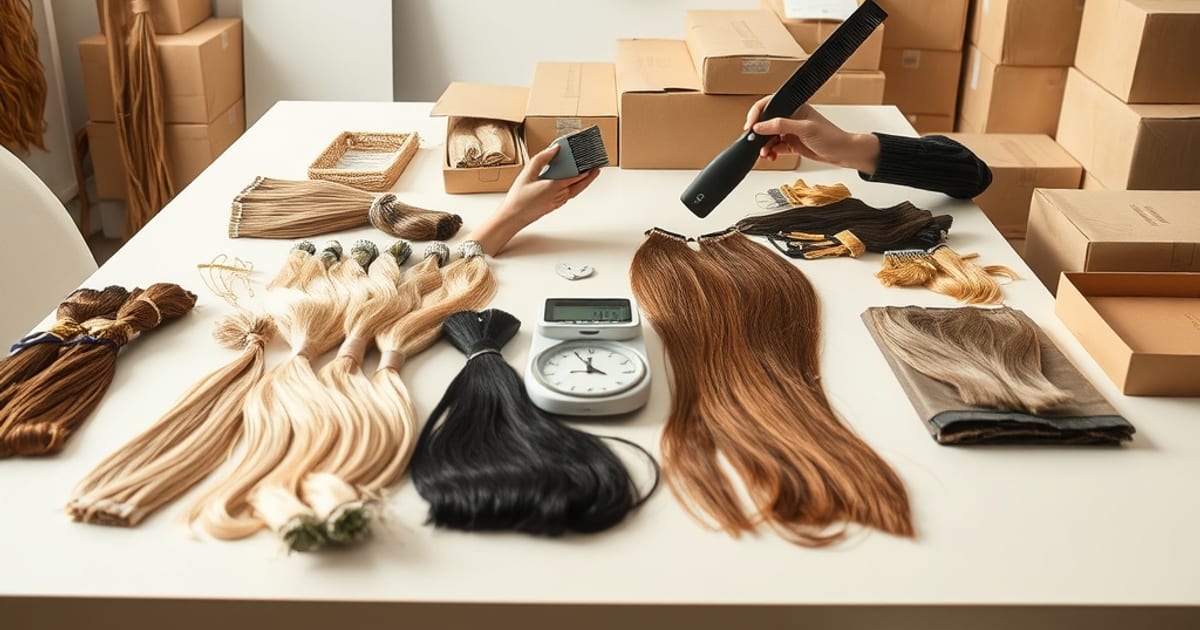
For salon owners, boutique buyers and international importers evaluating a new hair supplier, the first physical touchpoint is almost always a sample kit. A well-curated kit does…
For salon owners, boutique buyers and international importers evaluating a new hair supplier, the first physical touchpoint is almost always a sample kit. A well-curated kit does more than display texture and colour — it communicates professionalism, consistency and trust. For B2B buyers, a sample programme is a low-risk way to test a supplier before committing to bulk orders. For suppliers, it is a strategic sales tool that can shorten the decision cycle and build long-term partnerships. Understanding what belongs in a kit, how to price it fairly and how to scale the process separates serious wholesalers from casual sellers.
Why Sample Kits Matter in B2B Hair Sales
Human hair is a sensory product. Buyers need to feel the weight, see the sheen under different lighting and check the cuticle alignment before they place a large order. A sample kit removes guesswork. It lets a salon owner compare two bundles side by side, lets an importer assess packaging durability and lets a boutique curate a micro-collection for their clients without risking full-price stock.
In the wholesale hair market, trust is built through transparency. When a supplier sends a kit that accurately represents the grade, length and finish of the bulk product, the buyer knows exactly what to expect. That clarity reduces returns, reduces support queries and accelerates reorders. A supplier who invests in clean, consistent sample kits signals that they understand the buyer's workflow — from initial evaluation to shelf display.
For manufacturers and exporters, sample kits also serve as a quiet marketing asset. Every kit that reaches a salon counter or a distributor's warehouse keeps the brand visible between orders. The packaging, the care card and the tag all reinforce brand recognition, even when the buyer is comparing several suppliers at once.
What to Include in a Hair Sample Kit
The Hair Itself
The core of any sample kit is the hair. Buyers expect to see the exact grade they are considering, so the samples must match the bulk product in every visible way — texture, colour, density and finishing. A common approach is to include one or two short wefts or loose strands per style, enough to demonstrate drape and movement without using excessive product.
For a manufacturer like Suvita Hair Global, based in Delhi and exporting worldwide, sample kits typically feature the same virgin Remy Indian hair that appears in larger bundles. Because raw, virgin and Remy are the same grade at Suvita and differ only in the number of matched donors per bundle — raw from a single donor, virgin from two to three donors aged 20–30, Remy from three to five donors aged 20–30 — the samples should clearly label which donor configuration each piece represents. Buyers can then judge consistency across bundles rather than relying on description alone.
Packaging and Presentation
How a kit arrives matters as much as what is inside. Standard orders from Suvita Hair Global ship unbranded in plain packaging, which keeps costs low for buyers who are not yet ready for private labelling. However, a sample kit intended to impress a boutique or distributor often benefits from a more considered presentation.
Key elements to include:
- Clear labelling of length, grade and donor count on each sample
- A small care card with washing and storage instructions
- A printed or handwritten note describing the bundle contents
- Protective wrapping to prevent tangling during transit
For buyers who want to resell the samples as part of their own client consultations, private labelling is available on request. Custom boxes, branded bags, logo-printed tags and hang-cards, plus inserts and care cards, can be added — with a minimum of 50 pieces per private-label order. This lets a distributor hand the buyer a polished kit that already carries their own branding, strengthening the resale story.
How to Price Your Sample Kits
Cost-Based Pricing
Pricing a sample kit starts with understanding the true cost of the hair inside. Because Suvita Hair Global offers wholesale list pricing from 1.5 kg with no minimum order quantity and welcomes sample orders, the per-unit cost of a small sample is modest. However, buyers should account for packaging materials, labelling, shipping and the labour involved in assembling each kit.
A simple formula works well: calculate the hair cost per gram, multiply by the grams in the sample, then add packaging and shipping overhead. The result is a floor price — the minimum you can charge without losing money. From there, you decide whether the kit is a loss-leader designed to win a larger order or a revenue-generating product in its own right.
Value-Based Considerations
Beyond cost, value-based pricing asks what the kit is worth to the buyer. A salon owner who receives a kit that perfectly matches their client demographic and saves them weeks of sourcing will perceive higher value than one who receives a generic assortment. The more targeted the kit, the more you can charge.
Factors that increase perceived value include:
- Matching the kit to a specific market — curly textures for Afro-Caribbean salons, straight bundles for Asian markets
- Including a range of popular lengths so the buyer can test multiple options
- Offering a sealed, retail-ready presentation that the buyer can pass directly to a client
- Adding a care guide that positions the supplier as an educator, not just a vendor
Payment terms also shape pricing strategy. Suvita Hair Global requires 100% payment in advance by SWIFT bank transfer, which protects the exporter and simplifies cross-border transactions. Buyers should factor this into their cash flow when budgeting for sample programmes, especially when ordering kits for multiple regions.
Building a Repeatable Sample Program
Standardising the Process
The most effective sample programmes are repeatable. Rather than assembling each kit manually, create a template — a fixed set of lengths, grades and packaging options that can be reproduced quickly. This reduces errors, speeds up dispatch and ensures every buyer receives a consistent experience.
Shipping is another area where standardisation pays off. Suvita Hair Global ships via DHL Express with full export documentation — commercial invoice, packing list and certificate of origin — so buyers can expect clear, compliant paperwork with every order. For sample kits sent to new markets, including those documents in the kit itself builds confidence and removes customs friction.
A Practical Checklist for Your First Kit
Use this checklist when assembling a sample kit for a new B2B buyer:
- Confirm the buyer's target market and preferred textures
- Select two to three grades — raw, virgin and Remy — with matching donor configurations
- Include at least one short weft per grade, labelled with length and donor count
- Add a care card and a brief product description
- Choose plain packaging for first-time buyers or private-labelled packaging for repeat orders of 50 pieces or more
- Verify that DHL Express shipping and full export docs are arranged
- Confirm SWIFT payment is received before dispatch
Working with Suvita Hair Global on Samples
As a Delhi-based manufacturer and exporter, Suvita Hair Global supplies sample kits that reflect the same quality controls applied to bulk orders. Every strand in a sample kit undergoes the same inspection for cuticle alignment, colour consistency and weft security that buyers would expect from a full shipment. Because the company maintains no minimum order quantity and accepts sample orders alongside wholesale list pricing from 1.5 kg, buyers can test the product at low risk before scaling up.
For buyers who plan to resell samples or use them in client consultations, the private labelling option — custom boxes, branded tags, hang-cards, inserts and care cards — is available from 50 pieces per order. This flexibility means a boutique in London, a distributor in Lagos and a salon chain in Dubai can all receive kits that feel locally relevant, even though the hair originates from the same Indian source.
With proper care, Suvita hair lasts a minimum of 3–5 years in every grade, giving buyers confidence that the samples they evaluate will perform the same way in their clients' hands. Attachment intervals — tape and sew-ins redone every 6–8 weeks — are separate from hair lifespan and should be communicated clearly so buyers understand the full ownership picture.
What to Do Next
If you are ready to build a sample programme that supports your B2B growth, start by defining your buyer profile and the textures they request most often. Contact Suvita Hair Global to discuss sample kit options, private labelling requirements and shipping timelines to your target market. Request a small test order, evaluate the quality and packaging firsthand, and use that experience to refine your kit before scaling to larger private-label runs. A disciplined sample process today becomes a reliable revenue stream tomorrow.
Ready to source premium human hair — factory-direct?
Suvita Hair supplies wholesale extensions, wigs and bundles to salons, distributors and beauty brands across 189+ markets. Reply within 24 hours, DHL door-delivery, no middlemen.
- Factory-direct wholesale rates
- Sample orders accepted
- No MOQ — sample orders welcome
- IEC & GSTIN registered exporter
Suvita Hair Editorial
Seven+ years sourcing, grading, and exporting Indian human hair to wholesale buyers on every continent. We write to help salons and distributors buy smarter — no fluff, just what we actually see in the factory.
Related Articles

Inventory Management Hacks: Reducing Overstock Without Compromising Availability
Managing hair extension inventory is one of the most nuanced challenges facing salon owners, boutique buyers and wholesale distributors today. The product mix is wide, customer…
Read article
Bulk Ordering Hair Extensions: When to Split Shipments by Product Type
When you place bulk hair extension orders as a salon owner, boutique operator or distributor, one of the most impactful decisions you can make involves how and when you arrange…
Read article
Hair Extension Return Requests: How Salons Should Handle Defective Stock
When a salon receives a shipment of hair extensions from Suvita Hair Global, the expectation is flawless quality that meets the highest standards of professionalism. However…
Read article