
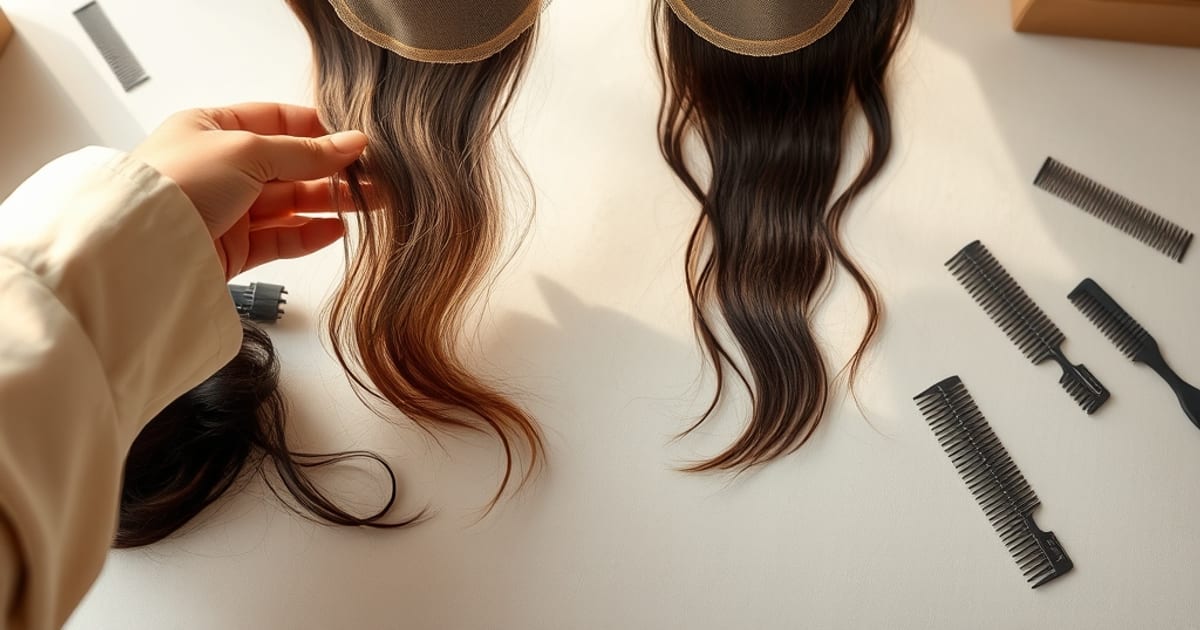
Walk into any wholesale showroom or scroll through any supplier catalogue and you will find frontals described as HD lace, transparent lace, Swiss lace, invisible lace and a…
Walk into any wholesale showroom or scroll through any supplier catalogue and you will find frontals described as HD lace, transparent lace, Swiss lace, invisible lace and a handful of other terms that are used loosely and often interchangeably. For salon owners and resellers, the confusion is expensive. If you buy the wrong lace type for a client base, you end up with frontals that look chalky on deeper skin tones, or lace that ghosts under ring light in photographs, or a product that simply will not hold up to a full install. Understanding the real difference between HD lace and transparent lace frontals — and knowing which one belongs in which situation — is one of the simplest ways to reduce returns and keep clients loyal.
What HD lace and transparent lace actually are
Both are Swiss-style lace frontals. Both are made from a fine, sheer mesh into which hair is hand-tied, and both are designed to sit on the forehead and hairline so that the knots and the mesh disappear against skin. The difference is not in the hair itself. It is in the construction of the mesh: how fine the threads are, how densely they are woven, and how the base has been tinted or treated before the hair is ventilated into it.
HD lace
HD stands for high definition, a term borrowed from broadcasting and cosmetics rather than from textile manufacturing. HD lace uses an exceptionally fine, low-density mesh with very thin threads. Because there is less material between the eye and the knot, the hairline reads as softer and less "dotted" on camera and in daylight. HD lace is also typically tinted to a neutral, almost translucent tone rather than a stark white or a heavy brown, which allows it to blend across a wider band of skin tones with minimal tinting work at the install stage. The trade-off is fragility. Finer mesh tears more easily, tolerates less tugging during a sew-in, and demands more care when it is cleaned and removed.
Transparent lace
Transparent lace is also a fine mesh, but the threads are marginally thicker and the weave is slightly denser. The base is tinted to a clear, neutral transparency rather than a skin-matching beige, which is why it works particularly well on lighter and medium skin tones where a beige-tinted lace can read as visible or slightly grey. Transparent lace is generally the more forgiving of the two during installation. It handles adhesive, tension and repeated handling better, and it is less likely to develop runs or bald patches at the hairline after a few weeks of wear. On deeper skin tones, transparent lace can sometimes require more careful tinting or a lace tint spray to avoid a pale halo at the hairline.
How to tell them apart before you buy
Because suppliers use the terms inconsistently, the label on the packaging is not reliable on its own. The most dependable approach is to inspect a sample physically. Suvita Hair Global supplies sample orders precisely so that buyers can do this before committing to a wholesale run, and it is worth building a short inspection routine.
- Hold the frontal against your own skin. Not against a white cloth, not against the packaging. Lay the lace edge across the back of your hand or wrist and look at it in natural light. HD lace tends to vanish almost completely; transparent lace usually shows a faint but visible mesh pattern at close range.
- Look at the base colour, not the hair. A neutral, near-colourless base suggests HD or a well-tinted transparent. A beige or brown cast suggests a standard tinted lace or a lower-grade transparent.
- Check the knot size under magnification. A phone camera zoomed in works well. Smaller, tighter knots with less visible bulb indicate a finer mesh and better ventilation.
- Test the stretch and recovery. Gently pull the lace edge between thumb and forefinger. HD lace stretches easily and springs back softly; transparent lace feels slightly crisper and holds its shape more firmly.
- Assess the mesh density by holding it up to a light source. The more light passes through evenly, the finer the mesh. Patchy light transmission suggests inconsistent weaving.
- Ask for the donor specification separately from the lace specification. Lace type and hair grade are two different questions. A supplier should be able to answer both clearly.
One practical warning: many frontals sold as HD are simply standard Swiss lace that has been heavily bleached at the knots and photographed under bright light. Bleaching reduces knot visibility but also weakens the knot, which shortens the usable life of the frontal. If the lace feels coarse in the hand but the knots look pale, you are probably looking at a bleached standard lace rather than a genuinely fine HD mesh.
When to use HD lace
HD lace earns its place in three situations. The first is camera-facing work: bridal styling, editorial shoots, content creation and any client who films regularly. The finer mesh photographs more cleanly, and the hairline holds up under ring lights and phone flashes where a denser lace can show a faint grid.
The second is clients with sensitive or reactive hairlines who want the lightest possible footprint. Because the mesh is thinner, the frontal sits flatter and moves more naturally with the scalp, which reduces the ridge that some wearers find uncomfortable after a few days.
The third is high-value installs where the frontal is being replaced regularly anyway. If a client books a fresh frontal every six to eight weeks as part of a sew-in or tape maintenance cycle, the reduced durability of HD lace matters far less, because the piece is not being asked to survive a long run.
Where HD lace is the wrong choice
HD lace is a poor fit for first-time wearers, for clients who are rough with their hair, and for any install that will be under heavy tension for months. It is also a poor fit for resellers whose customer base is largely beginners, because the fragility generates complaints that have nothing to do with the quality of the hair and everything to do with the handling of the lace.
When to use transparent lace
Transparent lace is the workhorse. It suits everyday wear, long-term protective styling, clients who swim or train, and any salon that needs a frontal to survive a full attachment cycle without babysitting. It is also the more sensible choice for volume resellers and boutique owners who cannot control how the end customer will treat the piece.
On lighter and medium skin tones, transparent lace often blends better than a beige-tinted lace and requires less tinting work at the install stage, which saves time in the chair. On deeper skin tones, it can be used very effectively, but the stylist should plan for a lace tint or a light foundation match along the hairline rather than relying on the base colour alone.
Matching lace to skin tone and undertone
The single most useful rule is to match the lace to the undertone, not the surface colour. Cool undertones tend to sit better with a neutral or slightly cool transparent base. Warm and golden undertones often sit better with a lightly tinted HD base or a transparent lace that has been tinted warm. Olive undertones are the trickiest and usually benefit from a custom tint applied at the install rather than a factory tint. Keeping a small stock of both lace types in the most-requested densities lets a stylist choose in the chair rather than guessing at the order stage.
Buying considerations for salons, boutiques and importers
Lace type is only one variable in a frontal specification. Density, hairline graduation, knot bleaching, cap size and the donor specification all affect how the piece performs, and a supplier who can speak clearly about all of them is usually a supplier worth keeping. At Suvita Hair Global, raw, virgin and Remy are the same grade and differ only in the number of donors per bundle — raw from a single donor, virgin from two to three matched donors, Remy from three to five — so the conversation about lace can be kept entirely separate from the conversation about hair quality.
For buyers testing a new supply line, the practical sequence is to order samples in both lace types at the density you sell most, install one of each on a mannequin or a willing model, and photograph both under the lighting your clients actually live in. Judge them after two weeks of wear, not on the day of install. Suvita Hair Global has no minimum order quantity, so a sample run is straightforward, and wholesale list pricing applies from 1.5 kg once you are ready to scale. Standard orders ship unbranded in plain packaging, and private labelling — custom boxes and bags, branded tags and hang-cards, logo printing, inserts and care cards — is available on request with a minimum of 50 pieces per private-label order. Payment is 100% in advance by SWIFT bank transfer, and shipping is by DHL Express with full export documentation including commercial invoice, packing list and certificate of origin.
One point worth repeating to clients: with proper care, Suvita hair lasts a minimum of three to five years in every grade. That lifespan refers to the hair, not the lace and not the attachment. Tape and sew-in attachments are redone every six to eight weeks, and a frontal's lace will show wear on its own schedule depending on how it is handled, cleaned and removed.
What to do next
Decide which lace type dominates your client base before you place any order. If your work is camera-facing and your clients refresh regularly, lean towards HD. If you need durability, volume and predictable performance across a broad customer base, lean towards transparent. Then order a small sample of each in your best-selling density, install both, and compare them in daylight and under artificial light before you commit to a wholesale quantity. Keep notes on which lace type each client preferred and why — that record will tell you more about your market than any catalogue description, and it will make your next order considerably easier to specify.
Ready to source premium human hair — factory-direct?
Suvita Hair supplies wholesale extensions, wigs and bundles to salons, distributors and beauty brands, with active buyers in 23 countries. Reply within 24 hours, DHL door-delivery, no middlemen.
- Factory-direct wholesale rates
- Sample orders accepted
- No MOQ — sample orders welcome
- IEC & GSTIN registered exporter
Suvita Hair Editorial with Deepak Kumar
Seven+ years sourcing, grading, and exporting Indian human hair to wholesale buyers on every continent. We write to help salons and distributors buy smarter — no fluff, just what we actually see in the factory.
Related Articles
13x4 vs 13x6 lace frontals: which one suits your client and install style
Choosing between a 13x4 and a 13x6 lace frontal is one of the most common decisions salon owners, boutique buyers and importers face when building a stock list. The two look…
Read article
How to choose between 4x4, 5x5 and 6x6 lace closures for a natural parting
Choosing the right lace closure for a natural parting is one of the most important decisions a hair stylist or salon owner makes — because the wrong size can create a visible seam…
Read article
Payment Terms for Bulk Hair Orders: Protecting Salon Cash Flow
An honest look at advance payment in the hair trade, and the five protections a salon can set around it to keep its cash flow safe.
Read article