
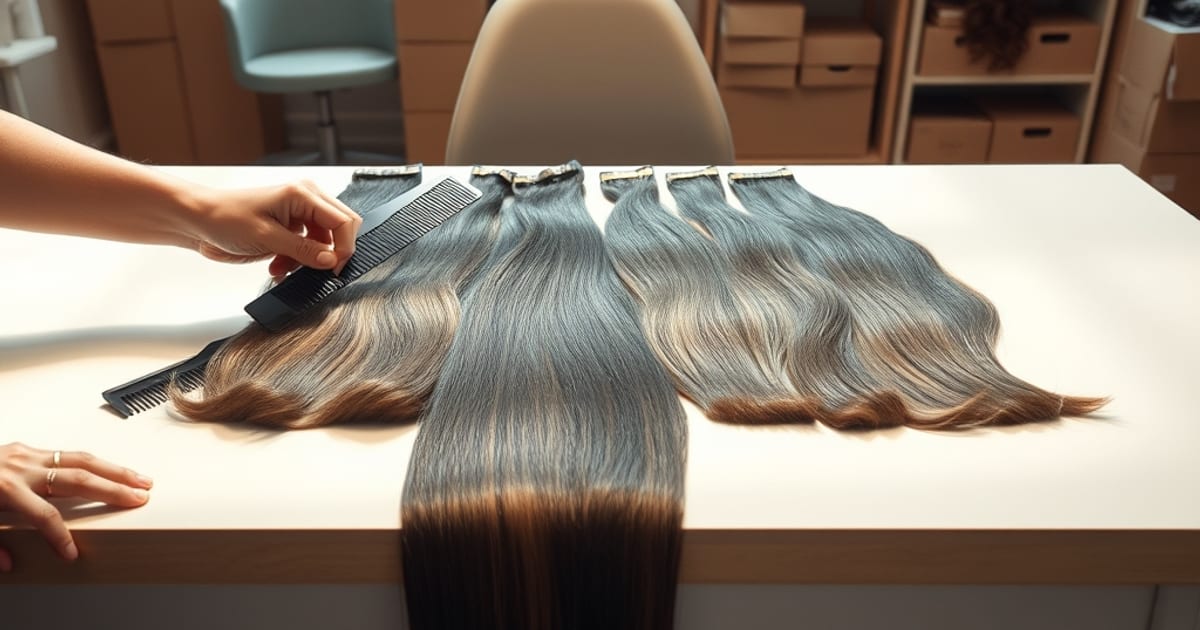
Ask ten stylists which weft they prefer and you will get a confident answer from each of them, and not the same answer twice. That is not because one of them is wrong. Genius…
Ask ten stylists which weft they prefer and you will get a confident answer from each of them, and not the same answer twice. That is not because one of them is wrong. Genius wefts and traditional machine wefts are built differently, behave differently in the chair and suit different clients, and the salons that get the best results are the ones that stock both and know when to reach for which. This guide explains how each weft is constructed, what stylists actually report from the floor, and how a salon or reseller should decide what to carry.
How the two wefts are built
The traditional machine weft
A machine weft is the workhorse of the extension industry. Loose hair is folded over a thread and sewn with an industrial machine, usually with a double or triple stitch, to produce a strong, flat track. The fold means a short length of hair, the return hair, sits above the stitching. The track is typically a few millimetres tall and fairly robust, which is why machine wefts have been the default for sew-in installs for decades. They can be cut to length, though cutting through the stitching can release a little hair at the cut end unless the end is sealed.
Suvita Hair Global manufactures machine wefts in both Single Drawn and Double Drawn grades, in the same 100 g bundles that most of the industry uses, so a salon moving from a distributor to a direct manufacturer does not have to change how it plans stock.
The Genius weft
The Genius weft, sometimes described as an ultra-thin or seamless weft, is a newer construction. Instead of folding the hair over the thread, the hair is bonded into a very thin, flat strip without return hair. The result is a track that is a fraction of the height and weight of a machine weft, lies almost flat against the scalp, and can be cut anywhere along its length without unravelling or shedding at the cut. It was developed to answer two long-standing complaints about machine wefts: bulk at the track and the short return hairs that can poke through fine hair.
Because the strip is bonded rather than sewn, it should not be sewn through with a needle; it is installed by beading, hand-tied methods or by sewing around the track rather than through it. That is the single most important thing a salon needs to know before switching.
What stylists report from the chair
Comfort and blending
On fine or thin hair, the Genius weft wins clearly. The track is thin enough to disappear under even a modest amount of natural hair, there is no return hair to prickle at the scalp, and clients report that the install feels lighter and less noticeable, particularly at the nape and around the ears. Stylists who specialise in hand-tied and beaded-row installs have moved to Genius-style wefts for exactly this reason.
On medium to thick hair, the advantage narrows. There is enough natural hair to hide a machine-weft track, the extra weight is not felt, and the client cannot tell the difference in the mirror. Many stylists in this situation stay with the machine weft because the result is the same and the product is more forgiving.
Durability and reinstalls
Machine wefts are tougher. They tolerate being sewn through, taken down, washed and reinstalled several times, and a well-made double-stitched track will outlast the hair itself. Genius wefts are durable when installed correctly, but the bonded strip does not like heat close to the track, aggressive combing at the root or being pierced, and a stylist who treats it like a machine weft will shorten its life. In practice a Genius weft reinstalls well when the salon follows the manufacturer's care guidance and poorly when it does not.
Speed and technique
Traditional wefts are faster for a classic sew-in because the stylist can work quickly along a strong track. Genius wefts reward stylists trained in beaded-row or hand-tied methods, who value being able to cut the weft to the exact width of each row with no waste and no sealing. Salons that have invested in that training often report shorter total install times once the team is fluent, because there is no cutting, sealing and doubling-up of tracks.
Cost, and what it means for margin
Genius wefts cost more per gram than machine wefts of the same hair grade, because the bonding process is slower and the strip has to be made precisely. Whether that matters depends on the service. For a premium hand-tied install on fine hair, the client is paying for comfort and invisibility, and the higher weft cost is a small share of the ticket. For a high-volume sew-in service on thick hair, the machine weft delivers the same result at a lower stock cost, and the margin difference adds up across a month.
The honest answer from most salon owners is that both products earn their place. What loses money is stocking only one and forcing every client into it.
A decision checklist for salons and resellers
Use the following questions to decide what to carry, and in what proportion.
- What share of your extension clients have fine or thin natural hair? The higher it is, the more Genius weft you should stock.
- Which installation methods is your team trained in today, and which are you planning to add in the next year?
- Do your clients keep installs for eight weeks and reinstall, or do they want a fresh install each time? Reinstall-heavy clientele favour the machine weft's toughness.
- How much heat styling happens near the root after the install? Frequent hot-tool use close to the track argues for machine wefts.
- If you resell to other stylists, which do they ask for by name? Stock what your customers already want, then educate them on the alternative.
- Can you keep both in the same hair grade, colour and texture so a client can move between them without a visible change?
A sensible starting split for a general salon is a majority of machine weft in the two or three best-selling lengths, plus a smaller holding of Genius weft in the same lengths for fine-haired clients. Adjust after a quarter based on what actually moved.
Sourcing both from one manufacturer
The practical advantage of buying both weft types from the same manufacturer is consistency. If the hair itself, the Virgin Remy grade, the drawing, the colour and the texture, comes from the same production floor, a client who starts on a machine weft and later moves to a Genius weft for comfort will get the same hair in a different construction, not a different product. Suvita Hair Global produces both on the same 100 g basis, in Single Drawn and Double Drawn, which lets a salon plan stock in one unit of measure and compare like with like.
There is no minimum order quantity for a first purchase, so a salon can order a bundle of each construction in the same length and texture and run a direct comparison in its own chair before deciding on a stock order. Wholesale list pricing applies from one and a half kilograms.
What to do next
If you are still deciding, do not decide on paper. Order one machine weft and one Genius weft in the same length, grade, colour and texture, install both on a mannequin, wash and dry them three times, and then hold them against a fine-haired client's head and a thick-haired client's head. The difference you can feel with your fingers and see at the parting will tell you what your salon should stock far more reliably than any comparison table, including this one.
Ready to source premium human hair — factory-direct?
Suvita Hair supplies wholesale extensions, wigs and bundles to salons, distributors and beauty brands, with active buyers in 23 countries. Reply within 24 hours, DHL door-delivery, no middlemen.
- Factory-direct wholesale rates
- Sample orders accepted
- No MOQ — sample orders welcome
- IEC & GSTIN registered exporter
Suvita Hair Editorial with Deepak Kumar
Seven+ years sourcing, grading, and exporting Indian human hair to wholesale buyers on every continent. We write to help salons and distributors buy smarter — no fluff, just what we actually see in the factory.
Related Articles
Understanding Hair Extension Weights: Why 100g vs 50g Matters for Salons
When a salon owner or reseller orders hair extensions, one of the most common sources of confusion is bundle weight. A listing that says 100g versus 50g can look like a simple…
Read article
Wig Cap Construction Types: Lace, Silk, and Mesh Compared for Salons
When a salon stocks hair extensions and wigs, the conversation rarely stays focused on the hair itself for long. Clients want to know how the piece will feel, how natural the…
Read article
How to Judge Remy Hair Quality Without Grade Numbers
Grade numbers on Remy hair are marketing labels. Here is the written spec to ask for instead and six tests to run on a delivery.
Read article