
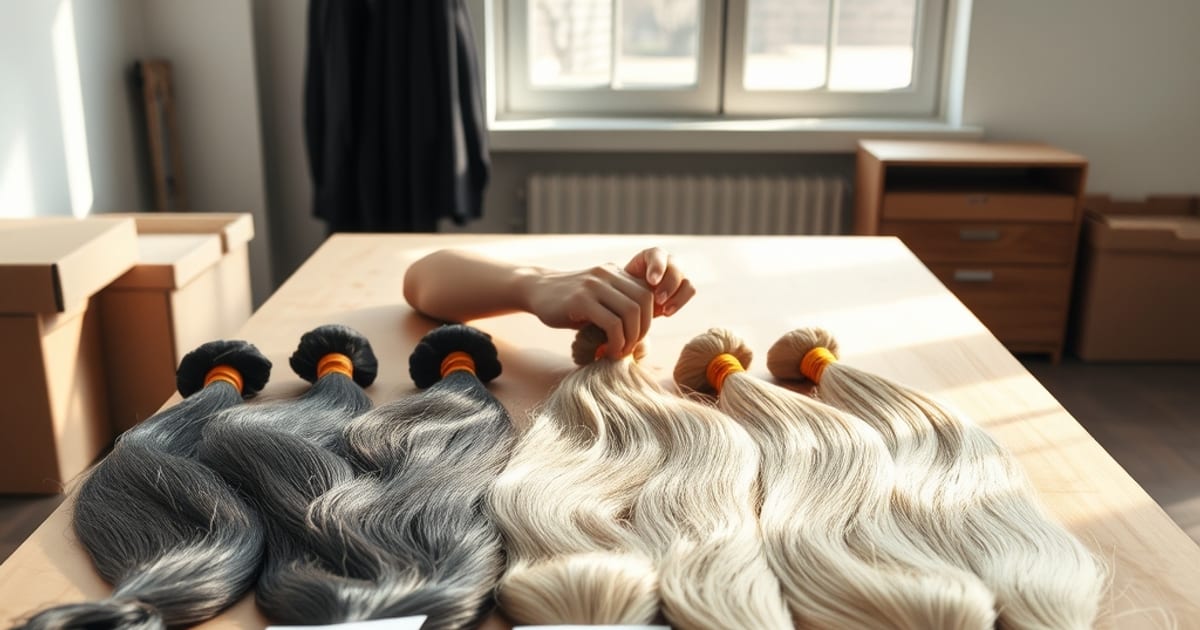
Walk through any wholesale hair marketplace and you will see the same three words used as if they were rungs on a ladder: raw at the top, virgin somewhere in the middle, Remy near…
Walk through any wholesale hair marketplace and you will see the same three words used as if they were rungs on a ladder: raw at the top, virgin somewhere in the middle, Remy near the bottom, with price bands to match. That framing is misleading, and it causes buyers to pay for a label rather than for what is actually inside the bundle. At Suvita Hair Global, all three terms describe the same grade of 100% Virgin Remy Indian human hair. The only thing that changes is how many donors contributed to a single bundle. Once you understand that, sourcing becomes considerably simpler and your conversations with suppliers become much sharper.
The label ladder is a myth: same grade, different donor counts
In the Indian hair trade, the words raw, virgin and Remy are used loosely and inconsistently. Some suppliers treat them as quality tiers. Others treat them as marketing language that can be attached to whatever stock is on the shelf. Neither approach helps a buyer who needs to plan a range, price it sensibly and reorder with confidence.
At Suvita Hair Global, the distinction is purely structural. Every bundle we manufacture and export is cuticle-aligned, ethically sourced and prepared to the same standard. What separates one label from another is donor count:
- Raw — a single donor per bundle.
- Virgin — two to three donors per bundle.
- Remy — multiple donors per bundle.
That is the whole difference. No grade is superior to another, and none outlasts another. With proper care, Suvita hair lasts a minimum of three to five years in every grade. The label tells you about consistency and donor matching, not about longevity or quality.
What each label actually tells you
Raw Indian hair bundles: single donor
A raw bundle comes from one donor. That means the strands within it share the same texture, the same natural colour variation and the same behaviour when washed, coloured or heat-styled. For a salon working on a client who wants a seamless, undetectable finish, that internal consistency is genuinely useful — there is no need to sort through a bundle to separate strands that behave differently from the rest.
Raw bundles are also the easiest to explain to a discerning client, because the story is simple: one head of hair, one bundle. The trade-off is availability. Single-donor hair is naturally limited in any given length and texture, so a raw range tends to be narrower and replenishment less predictable than a multi-donor range. Stock it where the client conversation justifies it, not as your volume line.
Virgin Indian hair bundles: two to three donors
Virgin bundles combine hair from two or three donors. In practice this is the balance most salons and boutiques settle on. You get a high degree of texture consistency, good availability across lengths and a price point that works for a broader client base. Because the donors are few, the bundles still behave predictably — colour uptake and styling response are close enough that a stylist is not fighting the hair.
For resellers building a core range, virgin is usually the sensible centre of gravity. It gives you enough consistency to promise a reliable experience without the supply constraints of single-donor stock.
Remy Indian hair bundles: multiple donors
Remy bundles draw on multiple donors. In the wider market, the word Remy is often used to signal that the cuticle is intact and aligned in one direction, which is what prevents tangling and matting. That alignment matters — but at Suvita it applies to all three labels equally, so it is not what distinguishes Remy here.
What Remy does give you is volume and depth of range. Multiple-donor bundles are the easiest to keep in stock across a wide spread of lengths, textures and weights, which makes them the natural workhorse for importers, distributors and salons running a busy book. If you need fifty bundles of the same specification next month and fifty more the month after, this is the label that will support that rhythm.
Why the market muddles these terms
Three things cause the confusion you will encounter when comparing suppliers.
First, the words are not regulated. Anyone can describe a bundle as raw, and many do, regardless of how many donors contributed to it. Second, some suppliers use the terms as a price ladder rather than a description, attaching a premium to whichever word sounds most exclusive this season. Third, buyers themselves sometimes assume that a higher price must mean a longer-lasting product, which pushes the whole conversation away from what actually determines lifespan: cuticle alignment, correct washing, heat discipline and proper aftercare.
The practical defence is to ask a direct question. Ask how many donors are in the bundle. A supplier who cannot answer clearly is either guessing or avoiding the question, and either way you have learned something useful before you have spent any money.
A practical checklist before you order
Whether you are testing a new supplier or expanding a range you already trust, work through the following before committing to volume.
- Confirm the donor count behind each label, in writing, so there is no ambiguity later.
- Ask for a sample in the exact length, texture and weight you intend to stock, not a representative swatch.
- Wash and style the sample the way your customers will, and note how it behaves after the first wash rather than on day one.
- Check the weft construction — machine, hand-tied or tape — against the attachment method your clients actually use.
- Clarify the attachment cycle separately from the hair itself. Tape and sew-in attachments are redone every six to eight weeks; that is the attachment, not the lifespan of the hair.
- Confirm packaging: standard orders ship unbranded in plain packaging, which suits resellers who apply their own identity later.
- Ask what private labelling options exist if you intend to build a brand, and what the minimum is for that service.
- Confirm payment terms, shipping method and which export documents will accompany the consignment.
Packaging, private label and logistics
For resellers and boutique owners, the unboxing experience is part of the product. Suvita Hair Global ships standard orders unbranded in plain packaging, so you can apply your own labels, ribbons or inserts at your end without unpicking someone else's branding.
If you would rather have the packaging arrive ready to sell, private labelling is available on request across every format: custom boxes and bags, branded tags and hang-cards, logo printing, inserts and care cards. The minimum for a private-label order is 50 pieces, which keeps a first branded run within reach for a salon or a small boutique rather than reserving it for large importers.
On the commercial side, there is no minimum order quantity at Suvita — sample orders are welcome, and wholesale list pricing applies from 1.5 kg. Payment is 100% in advance by SWIFT bank transfer. Shipping is by DHL Express, with full export documentation including the commercial invoice, packing list and certificate of origin. If you are importing for the first time, ask for a sample of that documentation set early so your customs broker can review it before the first commercial shipment rather than during it.
Matching the label to your customer base
There is no universally correct label to lead with. A salon whose clients are particular about blend and finish will often justify raw, even with a narrower range. A boutique building a broad retail shelf will usually find virgin the most workable core. An importer or distributor moving volume across many lengths will lean on Remy because the supply is deeper and the reorder rhythm is steadier.
Many successful ranges carry all three and let the client conversation decide. Because the grade is identical across the board, you are not asking a customer to trade quality for availability — you are asking them to choose between single-donor consistency and multi-donor depth. That is a far easier conversation to have, and a far more honest one.
What to do next: decide which of the three labels fits the clients you actually serve, request a sample in your target length and texture, and test it through a full wash-and-style cycle before you commit to stock. Ask the donor-count question directly, confirm the packaging and private-label terms you need, and check the export documentation before your first commercial order rather than after it. A supplier who answers all of that clearly, in writing, is one you can build a range on.
Ready to source premium human hair — factory-direct?
Suvita Hair supplies wholesale extensions, wigs and bundles to salons, distributors and beauty brands, with active buyers in 23 countries. Reply within 24 hours, DHL door-delivery, no middlemen.
- Factory-direct wholesale rates
- Sample orders accepted
- No MOQ — sample orders welcome
- IEC & GSTIN registered exporter
Suvita Hair Editorial with Deepak Kumar
Seven+ years sourcing, grading, and exporting Indian human hair to wholesale buyers on every continent. We write to help salons and distributors buy smarter — no fluff, just what we actually see in the factory.
Related Articles
How many hair bundles you need for a full sew-in, by length
Ordering hair for a full sew-in looks simple until you are standing in front of a client with a 26-inch request and a two-bundle budget. The honest answer is that bundle count is…
Read article
HD lace vs transparent lace frontals: how to tell them apart and when to use each
Walk into any wholesale showroom or scroll through any supplier catalogue and you will find frontals described as HD lace, transparent lace, Swiss lace, invisible lace and a…
Read article
13x4 vs 13x6 lace frontals: which one suits your client and install style
Choosing between a 13x4 and a 13x6 lace frontal is one of the most common decisions salon owners, boutique buyers and importers face when building a stock list. The two look…
Read article