
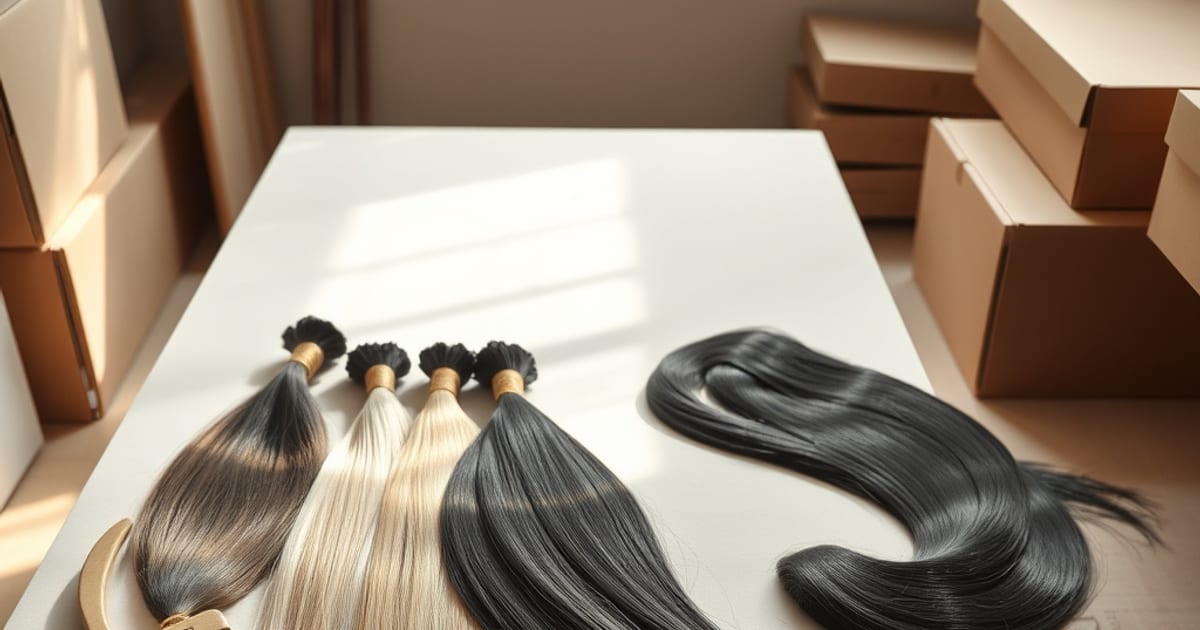
A plain explainer of weft hair: how a weft is made, the four main weft types, what stylists and wig makers use them for, and how many bundles to buy.
Weft hair is human hair sewn or tied along a thin strip at the root end so that it hangs like a curtain, ready to be sewn, beaded or clipped into a client's hair or onto a wig cap. This guide explains the weft types you will see on a wholesale price list, what each is used for, and how much to buy for a full install.
It is the starting point for buyers new to wefts. If you already know the basics and want a head-to-head comparison for a distributor's range, our hand-tied vs machine weft guide goes deeper on that one choice.
What a weft is
Loose hair is just strands. To make it wearable as an extension, the hair is lined up root to tip and fixed along a seam at the top. That seam is the weft, and the whole piece is often called a weft or, when sold by weight, a bundle. One bundle is 100 g.
Three things decide how a weft behaves on the head:
- How the seam is made: stitched by machine, tied by hand, or bonded flat.
- How thick and flexible the seam is: thicker seams are stronger but show more under fine hair.
- How the hair is drawn: double drawn hair has shorter strands removed so it stays thick to the ends; single drawn hair keeps natural tapering, with fuller roots and thinner ends.
Before any of that, check the hair itself. In our definitions, Raw hair is single donor, unprocessed, natural shades only, Virgin hair comes from 2 to 3 donors and is never chemically processed, and Remy hair comes from multiple donors with cuticles aligned. Cuticle direction matters most for wefts, because misaligned cuticles cause tangling along the seam.
Weft types compared
| Weft type | How it is made | Seam | Can it be cut to width? | Main uses |
|---|---|---|---|---|
| Machine weft | Hair stitched along a seam by machine | Thicker, very strong | Yes, with the seam sealed or folded | Sew-ins, wig making, clip-in sets, budget installs |
| Hand-tied weft | Small sections tied onto a fine thread by hand | Very thin and flexible | Not without risk of unravelling | Beaded-row installs on fine or thinning hair |
| Genius weft | Thin machine-made weft without a return hair at the top | Thin, flat, flexible | Yes | Beaded-row installs where the stylist wants to cut widths |
| Flat weft / flat-track | Hair bonded or stitched to a flat, thin base | Flat, low profile | Usually yes | Beaded or sewn installs that need to sit close to the head |
Machine weft is the workhorse of the bundle trade. Our machine weft bundle is what most wig makers and sew-in stylists buy. Hand-tied wefts cost more because of the hand labour and suit premium salon services; see our hand-tied weft range. The genius weft sits between the two, and flat weft extensions suit stylists who want the flattest seam they can bead.
What wefts are used for
Sew-ins and braid-down installs
The client's own hair is braided flat to the scalp and wefts are sewn onto the braids. Machine wefts are the usual choice because the seam takes repeated stitching. A closure (4x4, 5x5 or 6x6) or a frontal (13x4 or 13x6) usually finishes the top so no leave-out is needed.
Beaded-row installs
Small beads or rings are clamped onto a row of the client's hair and the weft is sewn to the row. Hand-tied, genius and flat wefts suit this because they lie flat and do not pull on fine hair.
Wig making
Wig makers sew wefts in rows onto a cap, then add a closure or frontal for the parting. Machine wefts are standard because the seam is strong and easy to handle.
Clip-ins and halos
Most clip-in sets and halo pieces are made from weft, with clips or a wire attached to the seam. If you sell clip-ins, the weft quality inside the set decides how long the set lasts.
How much weft to buy
Bundle counts depend on length, density and whether a closure or frontal is used. Longer hair needs more grams for the same look, because the same weight is spread over more length. The table below is a common starting point for a full sew-in on an average head; adjust for very thick or very fine hair.
| Length | Bundles without closure | Bundles with a closure or frontal |
|---|---|---|
| 10–16 inches | 3 (300 g) | 2–3 plus closure |
| 18–22 inches | 3–4 (300–400 g) | 3 plus closure |
| 24–28 inches | 4 (400 g) | 3–4 plus closure |
| 30 inches and longer | 4–5 (400–500 g) | 4 plus closure |
Our bundle calculator works this out for a given length and density, and the wholesale bundles page lists lengths and textures.
When you compare suppliers, ask for these in writing: donor count, whether the hair has been chemically processed, whether the cuticles are aligned, single or double drawn, and the weight of each bundle. Grade letters on bundles are vendor marketing labels with no industry standard, so they are not a substitute for those answers. Every grade we sell lasts 3–5 years with proper care.
Check a weft when it arrives
- Weigh it. A bundle sold as 100 g should weigh 100 g on a kitchen scale, without packaging.
- Run your fingers up the hair. Holding the tip, slide your fingers towards the seam. Aligned cuticles feel smooth in one direction and slightly rough in the other.
- Tug the seam gently. A few loose hairs are normal; a steady stream means the seam will shed in wear.
- Look at the ends. Compare the thickness at the tip with the thickness near the seam to see whether the hair is single or double drawn, as ordered.
- Wash one piece. Wash and dry one weft before installing the rest. Colour bleeding, a chemical smell or a lost curl pattern shows up in the first wash.
There is no minimum order. Most first buyers start with a sample kit or a few bundles, test them through washing, colouring and heat styling, then move to wholesale list pricing from 1.5 kg or volume pricing from 5 kg. Our guide to single drawn vs double drawn hair helps you decide which drawing to order.
Frequently Asked Questions
What is the difference between a weft and a bundle?
A weft is the strip of hair fixed along a seam. A bundle is the way wefts are sold, usually by weight: one bundle is 100 g of weft, often wound as one long weft that you cut to the lengths you need. In everyday trade talk the two words are used almost interchangeably.
Can you cut a weft?
Machine wefts and genius wefts can be cut to width, though cut ends of a machine weft are often sealed or folded to stop shedding. Hand-tied wefts are made from tied sections, so cutting them risks unravelling. If your stylists need custom widths, choose machine, genius or flat wefts.
How many bundles do I need for a full head?
A common starting point is 3 bundles (300 g) for lengths up to about 16 inches and 4 bundles for 24–28 inches, with one fewer if you use a closure or frontal. Very thick hair or high-volume styles need more. Our bundle calculator works it out by length and density.
Which weft type is best for fine hair?
Hand-tied, genius and flat wefts are thinner and more flexible than machine wefts, so they lie flatter and put less tension on fine hair. They are usually installed on a beaded row. Machine wefts are stronger but their thicker seam can show or feel heavy on very fine hair.
How long do weft extensions last?
Every grade we sell lasts 3–5 years with proper care: gentle shampoo, conditioner on the lengths, low heat and full drying before sleep. The install itself usually needs moving up every few weeks as the client's hair grows, and the same wefts can be reinstalled several times.
Ready to source premium human hair — factory-direct?
Suvita Hair supplies wholesale extensions, wigs and bundles to salons, distributors and beauty brands, with active buyers in 23 countries. Reply within 24 hours, DHL door-delivery, no middlemen.
- Factory-direct wholesale rates
- Sample orders accepted
- No MOQ — sample orders welcome
- IEC & GSTIN registered exporter
Suvita Hair Editorial with Deepak Kumar
Seven+ years sourcing, grading, and exporting Indian human hair to wholesale buyers on every continent. We write to help salons and distributors buy smarter — no fluff, just what we actually see in the factory.
Related Articles

Virgin Hair vs Processed Hair — Which is Better?
When salon owners and boutique resellers compare virgin hair versus processed hair, the decision shapes everything from client retention to repeat purchase rates. Both categories…
Read article
Indian Hair vs Brazilian Hair — An Honest Comparison
When salon owners, boutique resellers and importers evaluate wholesale human hair extensions, Indian hair and Brazilian hair consistently appear at the top of shortlists. Both…
Read article
Raw Temple Hair vs Remy Hair: What's the Real Difference?
When salon owners and boutique buyers compare raw temple hair versus Remy hair, the conversation often centres on texture, durability and how the hair was collected. Both…
Read article